Tuesday, April 30, 2013

Water scheme memorial

Very few locals would know that the Prince Alfred Guard Memorial forms the certral ornamental feature of Port Elizabeth's second oldest water reservoir.
 
In the early 1900's it was decided to supply water to Port Elizabeth from the Bulk and Sand Rivers and the St. George's Reservoir was constructed as a part of this scheme.  Excavation for the reservoir was commenced at the end of August 1906 and on 6 November 1907 the Treasurer-General, the Honourable Edgar H. Walton, turned the water into the new Service Reservoir on.  The two rnillion gallon reservoir is circular, 200 feet in diameter and the depth of the water is 10 feet 6 inches. 
 
This plague can be found at the back steps of the PAG Memorial.

Monday, April 29, 2013

The Arc of the 30th Meridian

Someone once sent me an email asking if I've ever been to the trig beacon on Lovemore Heights along with all the information about the beacon.  I'd never even heard of it and decided to drive up there, coming up against a closed gate and filing it away for future exploration.  After I took up Geocaching I noticed that there was a cache hidden close to the trig beacon and grabbed the opportunity to try and find it again, this time with directions from one of the previous cache finders.  The trig beacon is just that, a trig beacon, so there isn't really something very interesting to see.  The story behind it is of a lot more interest though, but I can now finally tick this spot as visited.  

Map of AfricaThe beacon is one in a series of 26, which are the first set of historic astronomical stations measured in order to establish the groundwork of the Arc of the 30th Meridian. The Arc of the 30th Meridian is a set of triangulation measurements effectively creating an arc from Port Elizabeth in South Africa to Cairo in Egypt through the entire African continent.  The purpose of the measurement was to determine the size and shape of the Earth.
 
This beacon represents the Southern most point of a chain of triangles Measured along the 30th meridian through Botswana, Mozambique, Zimbabwe, Zambia, Tanzania, Burundi, Uganda, the Democratic Republic of Congo, Sudan and ending near Cairo in Egypt.
Prior to 1999 the beacon was also the origin of the geodetic survey of South Africa.
The project was initiated by Sir David Gill, the Astronomer Royal at the Cape in 1879 and the final measurements were completed in the Sudan 1954.
The arc, known as the Arc of the 30th Meridian, can be connected across the Mediterranean Sea through Crete and Belarus to a similar arc measured through Europe terminating at North Cape in Norway. The European arc is known as the Struve Arc and together these two arcs cover nearly 105ยบ in latitude which is over 11650 Km in length.

This plaque on the trig beacon was unveiled by the President of the Institute of Professional Land Surveyors of the Eastern Cape, Mr C J Bollaert-Davies, on 8 June 2004, 125 years after the initiation of the project and 50 years after the completion of measurements.

Sunday, April 28, 2013

The PAG soldier

On the top of the central pedestal of the Prince Alfred Guard Memorial in St Georges Park is a life-size figure of a sergeant-major of Prince Alfred's Guard.  He is dressed in full uniform and is always standing at the ready to "charge".

Saturday, April 27, 2013

Celebrating 2000 posts

Today sees the 2000th post of Port Elizabeth Daily Photo.  PEDP first saw the light on 9 November 2007 under the penmanship of Sue and Max Hoppe, collectively known on here as SAM.  I discovered PEDP fairly early on and became a regular follower, trying to comment whenever I had a chance.  Sue and Max inspired me so much that I decided to even try my own hand at blogging.  The Firefly Photo Files was born.  In many ways that became a life changing moment for me. I was very surprised when I got an e-mail from Sue one day asking if I would be interested in taking over PEDP.  They were nearing 500 posts and felt that they needed a break.  I savoured the challenge, took over on 15 March 2009 and here I am, another 1500 posts later. 
 
Its been a roller coaster ride so far, mostly ups but every now and then I run out of inspiration, photos or time.  But that's never stopped me. What's a journey without a couple of bumps in the road anyway?  PEDP has become part of my life.  It has forced me to explore Port Elizabeth and its immediate surrounds even more than what I would have.  In doing so it also led me to many new places and back to ones I haven't been to in many years.
 
I often wish the blog would receive more comments and I wonder if its not just a waste of time.  Then I get an e-mail, a Facebook message or even a comment in person telling me how much somebody enjoys the blog, how certain pictures brought back memories or that they've seen something they never knew of and went to see or visit it.  That is what makes doing PEDP every day worth it.  
 
I have an absolute passion for Port Elizabeth and PEDP has become a record of places, things and memories to be found in and around Port Elizabeth.  Its one of the ways I can live out and share my passion.  A passion I hope would continue for another 2000 posts and beyond.       

Friday, April 26, 2013

Kings Beach silhouettes

Winter may be coming but for the past four days summer's been gracing us with her presence.  From the look of it she's also planning to hang around for the weekend.  Hey, I'm not complaining.


Thursday, April 25, 2013

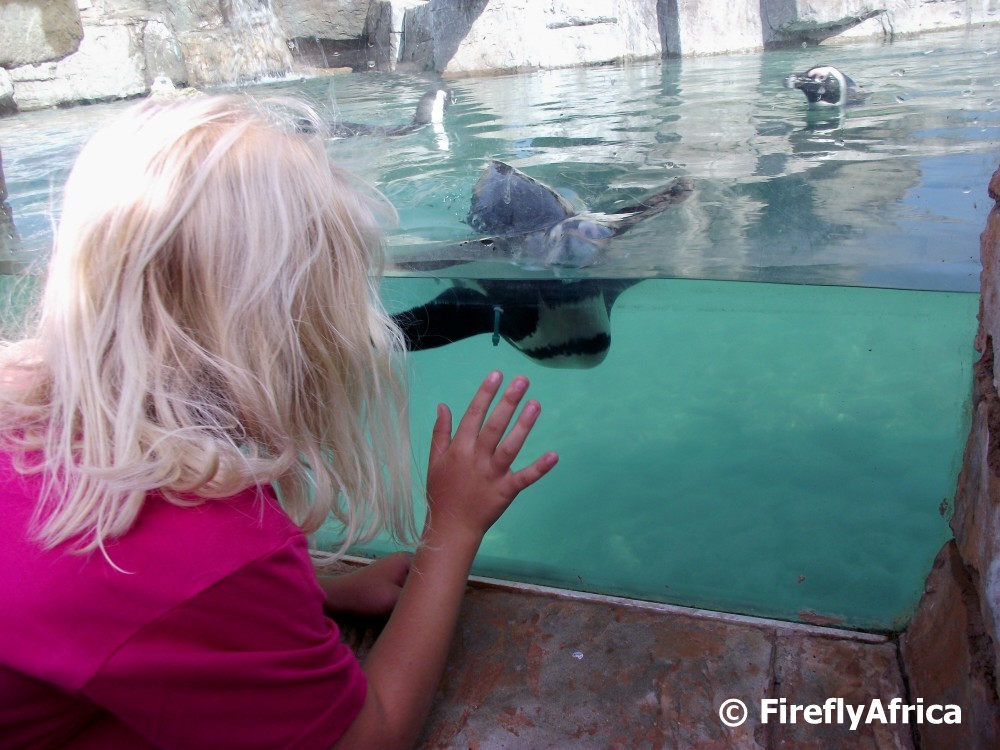
Penguin watching

Today is International Penguin Day and in celebration thereof I'm posting a pic of Drama Princess interacting with one of the African Penguin at SAMREC in Cape Recife.

Wednesday, April 24, 2013

Penguin pool

On Saturday I took Chaos Boy and 15, yes 15 of his friends to SAMREC for his 11th birthday party.  Eddie from SAMREC showed them around the centre and told them all about penguins, the ocean and why conservation is so important.  Here they're learning more about the birds in the penguin pool.  Thank goodness we got through the tour with nothing broken cause with this lot anything was possible.

Tuesday, April 23, 2013

Oceanos Lifeboat

4 August 1991 was a dramatic and fateful day on the Eastern Cape coastline with the sinking of the MTS Oceanos on the Wild Coast close to Coffee Bay, east of East London.  What does this have to do with Port Elizabeth, you ask?  After all 571 passengers on board was rescued, some of the lifeboats floated south-west along the ocean currents with one of them washing up on the coastline at Schoenmakerskop.  I got to visit the lifeboat for the first time the other day while searching for a geocache in the area.  Its situated in a marshy section of the coastline and is fairly overgrown, but I'm glad I finally got to visit it as its been on my "to do" list for quite some time now.

The Oceanos set out from East London on her way to Durban on 3 August 1991.  She headed into 40-knot winds and 9 m (30 ft) swells.  At about 21:30 while off the Wild Coast, a muffled explosion was heard and the Oceanos lost her power following a leak in the engine room.  The ship's Chief Engineer reported to Captain Yiannis Avranas that water was entering the hull and flooding the generator room.  The generators were shut down because the rising water would have short circuited them. The ship was left adrift.  Realising the fate of the ship, the crew fled in panic.  No alarm was raised and passengers remained ignorant of the events taking place until they witnessed the first signs of flooding in the lower decks.  At this stage, eyewitness accounts reveal that many of the crew, including Captain Avranas, were already packed and ready to depart, seemingly unconcerned with the safety of the passengers.

Nearby vessels responded to the ship's SOS and were the first to provide assistance. The South African Navy along with the South African Air Force launched a seven-hour mission in which 16 helicopters were used to airlift the passengers and crew to nearby settlements.  All 571 people on board were saved with a group of entertainment staff, under the leadership of Moss Hills, organizing the orderly evacuation of passengers by the helicopters.  The shipwreck is possibly the most recent instance where women and children were given priority when loading the lifeboats.  The entertainers were the last of the passengers lifted off the ship. The information is courtesy of Wikipedia

Monday, April 22, 2013

Courtyard pump

The well in the courtyard at No 7 Castle Hill must truly be one of the highlights to kids visiting the museum.  Not because of the hole in the ground, but for the pump that gets the water out the hole. The date on the pump is 1849 which means its been in place for over 150 years already.  Rain water collects in the well from the roof and kids are encouraged to try it out.  According to Grizel Hart, the curator of the museum, when the water was switched off in the area a few years ago, it was the only water they had to fill the loo cistern with. That's what I call practical history.

Sunday, April 21, 2013

Sunnyside Station

Geocaching is taking me to all kinds of places I haven't been to before.  And here I was thinking I've been everywhere. This specific Grannynasty cache took me a bit off the beaten track along a dirt road just west of the Van Stadens Bridge to the old Sunnyside Station, 29 1/2 miles from Port Elizabeth.  The station is on the narrow gauge railway line that runs from Port Elizabeth all the way to Avontuur in the Langkloof.  The line which used to be utilised by the Apple Express as well as freight and goods trains from the Langkloof and Gamtoos Valley isn't currently being used and is deteriorating due to floods and other natural elements as well as vandalism.  Very sad really.